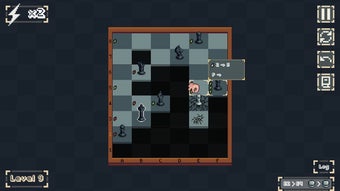
MateMorphosis reinvents chess as a transformable tactical puzzle
MateMorphosis, from Wise Monke Entertainment Studio, is a Mac strategy puzzle that reframes chess into a turn-based hunt for the rival king. Players navigate discrete boards where each turn demands positional foresight to corner the opponent and complete staged objectives. The game layers progressively introduced obstacles and variant rules across levels while preserving tight, puzzle-focused encounters. Aimed at fans of turn-based strategy and chess variants, it rewards planners who enjoy escalating, logic-driven challenges on desktop platforms.
Capture-to-transform flips standard chess logic
The core mechanic forces you to rethink piece value: capturing an opponent's piece lets your piece assume that piece's movement and abilities, so every exchange changes your available options. The stated objective on many boards is to hunt the rival king, which converts standard positional tactics into identity management. That design converts individual captures into planning pivots, turning familiar chess motifs into a puzzle about sequence and role economy.
Level design favors focused, stage-based single-player puzzles
The game presents discrete tactical boards with specific objectives rather than open matches, and documentation describes it primarily as a puzzle-strategy experience. Platform support spans Mac, Windows, Linux, and Nintendo Switch, and Mac requirements include OS X 10.7 or later, Intel Core M or Apple M1, 1 GB RAM, and 500 MB storage. A demo was released before the full launch so players can sample the basic progression.
A retro audio-visual skin masks modern puzzle depth
Visuals use a pixel-art aesthetic paired with immersive sound effects that frame each board as a compact scene. The developer positions that look-and-sound blend as a retro-modern fusion, combining 8-bit style with deliberate level design. Audio cues support readouts of exchanges and piece changes, which helps the player track evolving movement rules during long sequences of turns.
Difficulty and progression emphasize escalation and replayability
Stages introduce new mechanics and obstacles as you progress, producing a steeper challenge curve described by the developer and community as maddening yet rewarding. The design follows an "easy to learn, hard to master" posture, so early boards teach movement rationales while later puzzles demand long-range planning. Replay value comes from solving boards with different transformation sequences rather than open-ended randomization.
In summary, a methodical pick for solitary puzzle strategists
MateMorphosis is a thoughtful choice for players who prefer cerebral, stage-based puzzles and enjoy constant tactical reevaluation; its focus on chess-variant puzzles suits solo play more than competitive matches. Players seeking streaming-friendly action or multiplayer skirmishes should note the game's puzzle orientation and escalating challenge as the primary design direction.